
Mapping the path to one cent electricity
A new Astera Resident investigates not just how transformative fusion could be, and what would have to be true to get there.
A new era of power generation is coming with nuclear fusion. Fusion technology mimics the enormous flux of energy powering the core of the stars like our Sun. Small atoms smash together under such immense pressure and temperature that they fuse into heavier elements. The process liberates roughly four million times more energy per kilogram than burning fossil fuels.
Make no mistake: Fusion is a hard problem requiring immense innovation. But the energetic upside is compelling. If fusion power can reach 1 cent per kilowatt-hour — 5 to 10 times cheaper than today’s cheapest new-build power generation — it may enable other world-altering technologies, from affordable desalination and interplanetary space travel, to other leaps we can’t yet readily imagine.
Dozens of companies and governments around the world are betting on nuclear fusion to revolutionize how we power life on Earth. But despite $10 billion of investment, the road to these transformative promises is economically cloudy.
The interesting question is not really what life could look like with one cent electricity, but rather what sequence of events would make it possible? What needs to be true to achieve 1¢/kWh?
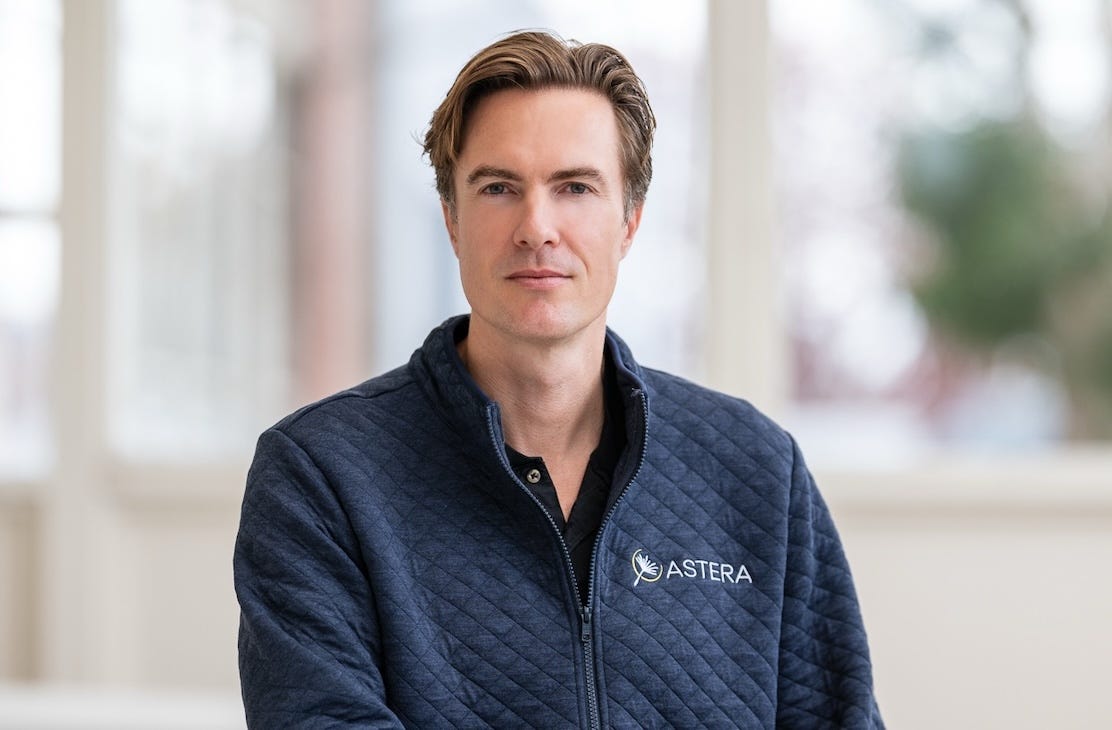
“It’s a wildly aggressive target,” says Damien Scott, a technologist working on fusion systems. “It may well be implausible.”
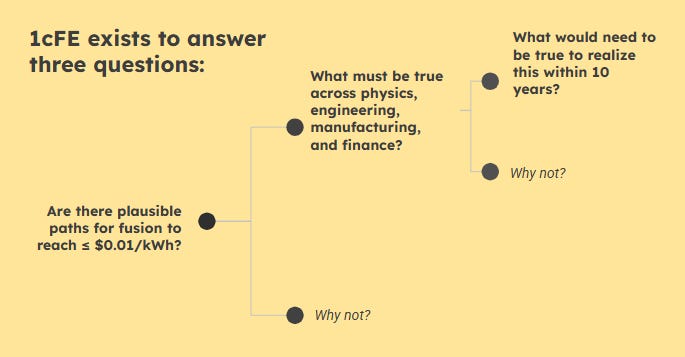
In 2025, Scott began a residency at Astera Institute to lead 1cFE, an initiative that models the potential costs of fusion energy, and determines whether (and how) any technologies have a path to 1¢/kWh electricity within 10 years. Scott’s goal is to understand what constraints limit the various scientific routes toward sub-cent fusion, resolving to make them visible before years of effort and billions more dollars pour in.
Follow along 1cf.energy

MANY PATHS TO CLEANER ENERGY
Scott’s interest in electricity came out of necessity. He spent his childhood years living off the grid on a remote farm in Botswana, forty miles from the nearest gas station. The wet seasons could wash out the roads, cutting them off further. Scott and his family learned to improvise. They drilled wells for their water, and jerry-rigged 1990s-era solar panels for power.
He later studied concentrated solar thermal power while earning a degree in applied physics at the University of Sydney, gravitating toward engineering projects that worked under harsh conditions. This led him to Williams Racing in Formula 1, where he helped create the team’s applied technology division. It was an extreme environment for engineering. F1 requires rapid iteration, unforgiving constraints, with constant high-stakes (and public) feedback. Scott went on to found an autonomous and electric vehicle fleet simulation and optimization startup, Marain. And these experiences crystallized his philosophy as a technologist: Before building expensive hardware, model enough to reduce uncertainty. In other words, Model twice. Spend once.
Marain was acquired by General Motors. After spending two years at GM Scott departed and began exploring what problems to work on next. “I kept coming back to fusion,” he says.
He studied the landscape and was struck by the quality of privately funded engineering teams in the space. The technologies were promising. But he couldn’t find a clear measure of how promising. “If we take the culmination of the last 75-80 years,” he says, “and everything breaks the right way, how cheap could it be?”
WAYFINDING IN FUSION
Right now, the future of fusion is like a summit hike through dense forest. Many paths exist, some more delineated than others thanks to the hard work and good fortune of early trailblazers. But each tortuous trail faces unique obstacles.
In order to reach the right extreme conditions to achieve fusion on Earth, some use lasers to rapidly compress fuel. Other technologies use magnets to confine plasma. Nuclear fusion releases energy as electromagnetic radiation, fast moving ions and neutrons. What researchers do with that resulting burst of energy also varies. Many proposed fusion plants resemble current fission plants: They generate heat, boil water, spin turbines, and funnel electricity into the grid. Alternatively, a new model for plants could convert the energy of fast moving ions directly into electricity: plasma expands against the magnetic field that’s confining it, which induces a current.
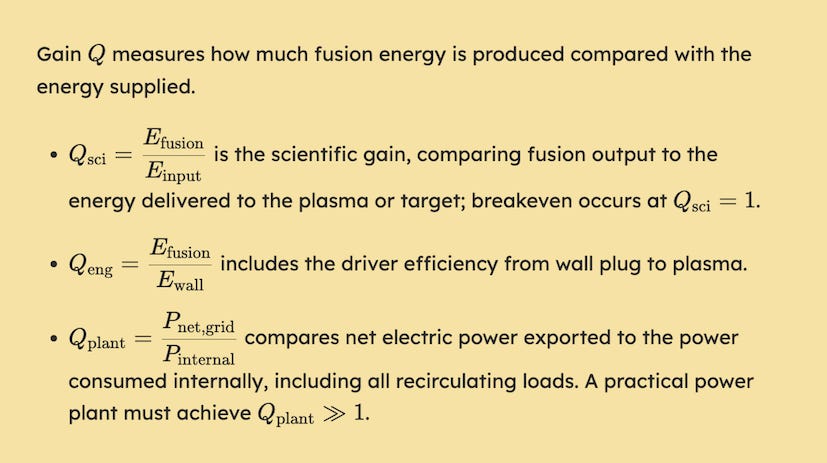
Two feasibility metrics are particularly important when comparing technologies at the experimental stage: the triple product and the gain. Triple product represents the threshold plasma density, temperature, and confinement time required for a technology to trigger fusion Gain measures how much more energy a technology creates with fusion compared to the amount of energy it needs to start and sustain it. Small-scale experiments at Lawrence Livermore National Lab have yielded greater energy (8.6 MJ) than that delivered by a laser (2.08 MJ). This represents a theoretical, “scientific gain,” as opposed to the engineering gain or “plant gain,” for a whole facility. The inefficiency of the Livermore Lab laser makes it so that the system still uses much more energy than it generates.
As an Astera resident, Scott’s 1cFE is building open-source cost models that compare these many paths on the basis of their potential upsides and constraints. For example, analyses peg the floor of fusion systems relying on steam generation at 0.5¢/kWh. “The cost of steam turbine processes really constrains,” Scott says. “It may be harder for fusion approaches that generate heat to get to that one cent target.” Direct energy conversion bypasses the costs of steam boilers, but it requires different fuels and less well-studied physics and engineering.
Tradeoffs like this are not necessarily dealbreakers. No leading technologies have yet been ruled out of the one-cent pursuit. But the optimal approach at this point in fusion’s development is to carefully scrutinize how we’ll reach one cent and beyond. And that, according to Scott, requires working backwards.
FRONTIER BACKCASTING
As of 2025, no private company has demonstrated scientific gain above 1. Some are approaching, with forecasts of hitting scientific breakeven next year. We are seeing new facilities break ground every year with private-public partnerships. Several companies claim they will have carbon-free power plants online before 2030, and tech giants like Google and Microsoft have already signed power purchase agreements.
The hope to finally deliver fusion electricity after decades of work has never been higher, Scott says, but his ambitions aim even higher. 1cFE’s role is to investigate the plausibility of sub-1¢/kWh fusion power. “Solar is a very instructive analogy, because the fuel cost is zero, very similar to fusion where the fuel cost is minimal,” Scott says. “We can do solar plus storage at 5¢/kWh, and that is getting cheaper.” The key innovation lies in how to manufacture the device that produces electricity not just cheaply, but cheaper than anything else.
Hitting 10¢/kWh would make fusion competitive in some markets. At 5¢/kWh, the market balloons toward profound change. But at or below 1¢/kWh is where the more profound changes can emerge — it’s an anchor that exposes the limits facing fusion technology.
1cFE begins with this target, then asks what would have to be true — in physics and economics — for that world to exist. This so-called “frontier backcasting” reveals constraints and the required levers.
Frontier backcasting helps focus a subset of the field’s research, investment, and policy, toward the most aggressive end goals by exposing what’s actually possible. “It is common to overestimate what is possible in one year and underestimate what is possible in ten,” Scott says. Consider the fallen cost of launching payloads into low Earth orbit. Between 2000 and 2010, LEO launches hovered between $8,000 and $12,000 per kilogram. SpaceX sought to lower costs by an order of magnitude. But this would not be possible with incremental innovations. It was only possible with unprecedented reusability. Their bold target forced them to consider an entirely different gameplan, and today reusable rockets have already cut costs by a factor of 10.
“Which levers are unavoidable to reach 1¢/kWh?” Scott asks. “We will use this target in fusion to expose how far the levers must move, and in what order.”
ESTIMATING UNCERTAINTY
1cFE will help compare different approaches to reaching cheap electricity. The current landscape of proposals includes mature technologies with relatively predictable lifetime costs as well as much newer technologies that are harder to quantify.
So how will the team quantify approaches comprising such varying degrees of uncertainty?
The first layer of modeling estimates capital cost, interest, operational costs, and learning rates — the change in cost that comes over time with more production experience. They also assign a “technology readiness level” to subsystems or components. “If it’s a laser that has only been made once, that’s on the lower end of the TRL scale. Whereas, if you are reusing fast-switching capacitors found in a bunch of other industries, that’s much higher.”
But what about components that simply don’t yet exist? Although the cost of new concepts that depend on not-yet-invented technology are more difficult to quantify, 1cFE’s modeling can benefit here too. Rather than guessing what unproven components will cost, the team inverts the question: working backwards reveals what those components would need to cost to make new ideas viable. "No one has built a direct energy capture system at power-plant scale," Scott says. “We explore what does it need to cost, at what efficiency and lifetime, and how much room is there between the raw materials and the finished component for manufacturing learning to bring that cost down?"
OUTPUTS
In a one-year residency with Astera, Scott is leading a team with expertise in physics, systems engineering and software to create models, outline assumptions, and identify both promising and discouraging roadmaps.
Like other Astera residencies, 1cFE aims to unlock a future of abundance and human flourishing. The typical Astera project leans into the messy uncertainties about how technology will evolve. For 1cFE, this means applying rigorous cost analysis and technological assessments to expose a plausible path to abundant energy. This is a path to innovation that has too often been neglected in favor of incremental improvements. And 1cFE’s approach is open-science from idea to result: They will publish everything, including negative results as well as fully transparent corrections. “We encourage others to find errors, and we will correct them as we go,” Scott says. “The commitment is to keep the record honest and not just open.”
Later this year, 1cFE will deliver the first systematic, open-source techno-economic comparison of fusion pathways against a sub-cent target. They will publish datasets, a report benchmarking new AI tools, and reproducible code. Scott envisions a public dataset listing 10 to 15 fusion concepts and the technoeconomic conditions required for each of them to reach 1¢/kWh.
They will run two workstreams in parallel: backcasting to the technical, industrial, and policy constraints implied by a one cent target; and testing where AI can accelerate the design-build-test-learn cycle.
Researchers have already published a lot of useful fusion information, but data is largely fragmented across formats that don’t lend themselves to quantitative, and prospective comparisons. 1cFE is building the missing layer: a dynamic database of levelized costs across approaches. The team’s technoeconomic assessment will make it cheaper to add concepts, rerun analyses, and compare approaches side-by-side.
For companies interested in targeting 1¢/kWh, 1cFE’s work will help identify a path forward. The goal is not to prove out or favor any particular confinement system or fuel choice; it is to slash uncertainty so that technologists and investors pursuing ultra low cost fusion can direct resources into the ideas most likely to radically change humanity.
“Fusion is frequently described as clean, limitless, and virtually free,” Scott says. “Those words need to be quantified.”